🇺🇸 AMERICA’S NEXT PRESIDENT: NEW POLLS REVEAL WHO VOTERS ARE CONSIDERING FOR 2028 — AND WHY THE FUTURE OF THE WHITE HOUSE IS ALREADY BECOMING A MAJOR CONVERSATION
 The next presidential election is still ahead, but Americans are already discussing the future of the White House. New national surveys reveal the political figures attracting attention, the issues shaping voters’ opinions, and the growing uncertainty surrounding the 2028 presidential race.
The future of American politics is once again becoming a subject of national discussion.
Every presidential election brings an important question: Who should lead the United States next?
For millions of Americans, this question is about much more than choosing a name on a ballot. It is about the economy, employment opportunities, healthcare, immigration, national security, education, taxes, and the direction of the country over the next four years.
It is also about leadership, experience, political values, and whether the country should continue with familiar political figures or consider a new generation of leaders.
Although the 2028 presidential election is still in the future, Americans are already beginning to discuss potential candidates. Recent national polling from Emerson College and The Economist/YouGov provides an early look at the people attracting attention within the Democratic and Republican parties.
The numbers are interesting, but they also require careful interpretation.
Some surveys present respondents with a list of possible candidates. Others allow voters to mention a name without being given a list. Some ask about party nominations, while others ask about the general presidential election.
These differences matter because a person who receives support in a party-primary survey is not necessarily receiving the same level of support from the entire American electorate.
Nevertheless, the findings offer an opportunity to understand the political conversation taking place in the United States.
So, what are Americans thinking about 2028?
Which political figures are attracting attention?
What issues matter most to voters?
And perhaps most importantly, what should people understand before interpreting the latest presidential polling numbers?
Let’s examine the findings and the larger political questions behind them.
PART ONE: THE 2028 PRESIDENTIAL ELECTION IS ALREADY ENTERING THE NATIONAL CONVERSATION
The United States has a presidential election every four years, and the next scheduled election is in November 2028.
Although that date may seem far away, political discussions often begin years before voters enter polling stations.
Potential candidates, political organizations, journalists, researchers, and ordinary citizens frequently discuss the next election long before the official campaign season begins.
This early period is important because it allows Americans to consider what they want from their next president.
Some voters may prioritize economic policies.
Others may focus on immigration, healthcare, international relations, education, or government spending.
There are also voters who place particular importance on a candidate’s previous experience, leadership style, communication, or ability to work with Congress.
These differences explain why presidential elections are rarely decided by one issue alone.
A candidate may attract attention because of one policy position but face questions about other parts of their political record.
Another candidate may have extensive government experience but encounter criticism from voters who want a different approach.
This is one reason early presidential polling should be viewed as a snapshot of public opinion rather than a final judgment about the election.
At this stage, the political landscape can still change significantly.
Potential candidates may decide not to run. New political figures may enter the conversation. Party supporters may reconsider their preferences. Major national events can also change which issues voters consider most important.
The latest surveys therefore provide useful information, but they do not establish who will become the next president.
They tell us what some Americans are thinking at the time the surveys were conducted.
And that is an important distinction.
PART TWO: EMERSON COLLEGE POLLING REVEALS INTERESTING NAMES IN THE 2028 RACE
One of the most closely watched recent surveys comes from Emerson College Polling.
The national survey was conducted between November 14 and November 16, 2026, and included 1,000 U.S. voters.
The poll examined possible candidates for the 2028 presidential nominations of both major political parties.
An especially important feature of the survey is that respondents were asked two different types of questions.
First, they were allowed to provide an open-ended answer.
Then, they were presented with a list of potential candidates.
These two approaches produced different results.
Understanding that difference is essential when discussing the findings.
The Democratic presidential field
In the open-ended Democratic primary question, Jon Ossoff received 17% of responses.
Alexandria Ocasio-Cortez received 12%.
Gavin Newsom received 8%.
Pete Buttigieg and Kamala Harris each received 6%.
Andy Beshear received 4%, while Mark Kelly received 3%.
These results show that several different political figures are appearing in voters’ early discussions about the Democratic nomination.
Jon Ossoff’s appearance near the top of the open-ended results is particularly notable because respondents were not simply choosing from a list provided by the pollster.
Instead, they were asked to identify a candidate themselves.
That distinction provides a different perspective on name recognition and spontaneous voter preferences.
However, it does not mean every respondent has carefully studied each potential candidate or made a final decision.
Some people may be familiar with a particular politician because of recent news coverage. Others may have followed that person’s political career for years.
The results should therefore be understood as an early measure of expressed preferences rather than a complete evaluation of the candidates.
What happened when voters received a list?
Emerson also presented respondents with a closed-ended list of potential Democratic candidates.
The results changed:
- Jon Ossoff — 17%
- Kamala Harris — 16%
- Alexandria Ocasio-Cortez — 15%
- Pete Buttigieg — 14%
- Gavin Newsom — 11%
- Andy Beshear — 7%
- Mark Kelly — 4%
- Josh Shapiro — 3%
- JB Pritzker — 3%
The difference between the open-ended and closed-ended results is worth examining.
For example, Kamala Harris received 6% in the open-ended question but 16% when voters were given a list.
Pete Buttigieg also moved from 6% to 14% between the two question formats.
Why would that happen?
One possible explanation is that respondents may not immediately think of every politician they would consider supporting.
When a survey presents a list, it reminds respondents of additional possibilities.
This is a normal feature of survey research.
An open-ended question measures which names come to mind without prompting. A closed-ended question measures preferences among the options provided.
Neither format automatically provides a complete picture of what Americans will do in a future election.
The important takeaway is that the Democratic field remains broad, with several names appearing in the discussion.
There is no reason to treat an early survey as a final decision by Democratic voters.
PART THREE: THE REPUBLICAN FIELD ALSO SHOWS DIFFERENT PREFERENCES
Emerson College also examined potential Republican presidential candidates.
The Republican results attracted attention because Marco Rubio and JD Vance appeared prominently in the survey.
In the open-ended Republican primary question, the results included:
- Marco Rubio — 36%
- JD Vance — 20%
- Ron DeSantis — 7%
- Donald Trump — 7%
- Thomas Massie — 7%
This question allowed respondents to name a candidate without first being presented with a fixed list.
The poll then offered respondents a closed-ended list.
The results were:
- Marco Rubio — 44%
- JD Vance — 24%
- Ron DeSantis — 9%
- Donald Trump Jr. — 6%
The difference between the two questions is important.
The open-ended question identified Donald Trump, while the closed-ended question included Donald Trump Jr.
These are two different people, and their results should never be combined.
The findings also demonstrate why it is important to read the exact wording of a survey before sharing its numbers.
A headline that simply says a candidate received a particular percentage may leave out important information about the question, the sample, and the available choices.
The November Emerson poll also reported that the Republican Party had a 35% favorable rating and a 56% unfavorable rating among respondents.
The Democratic Party received a 44% favorable rating and a 47% unfavorable rating.
These party-favorability figures measure general opinions about the political parties, not support for a particular presidential candidate.
They provide additional context about the political environment, but they should not be interpreted as direct election results.
For voters trying to understand the 2028 race, the central lesson is that the Republican conversation is also developing across several potential candidates.
Different voters may have different priorities when considering who should represent their party.
Some may focus on policy continuity.
Others may prefer different leadership styles or approaches to government.
Still others may want to see a candidate who emphasizes issues that they believe have received insufficient attention.
These are questions that will continue to shape political discussions as 2028 approaches.
PART FOUR: THE ECONOMIST/Y OUGOV POLL PROVIDES ANOTHER VIEW OF VOTER PREFERENCES
Another important source of information is the November 9–11, 2026, Economist/YouGov national survey.
The poll included 1,685 U.S. citizens and reported a margin of error of approximately three percentage points.
It examined a wide range of subjects, including the 2028 presidential nominations, political parties, the national direction, and opinions about the current administration.
Its presidential nomination questions also used open-ended responses.
This means respondents were asked to identify whom they would most likely support in their preferred party’s primary.
Kamala Harris appears prominently in the Democratic results
Among respondents who intended to participate in the 2028 Democratic primary or caucus, Kamala Harris received 20%.
Jon Ossoff received 15%.
Gavin Newsom received 13%.
Alexandria Ocasio-Cortez received 12%.
Pete Buttigieg received 10%.
Other names included:
- Mark Kelly — 4%
- Josh Shapiro — 3%
- Andy Beshear — 3%
- JB Pritzker — 3%
- Bernie Sanders — 2%
- Zohran Mamdani — 2%
- Cory Booker — 2%
- James Talarico — 1%
- Hillary Clinton — 1%
These figures illustrate how many different political figures are part of the early Democratic discussion.
Harris’s result is particularly relevant because she has already held national office as vice president and was the Democratic presidential nominee in 2024.
However, previous national experience does not automatically determine what voters will decide in another election.

Voters may evaluate a candidate’s previous record, policy proposals, communication, political priorities, and approach to future challenges.
They may also compare those qualities with the people entering the race for the first time.
The YouGov results provide one measurement of early interest, but they do not establish a final Democratic nomination contest.
Republican preferences in the YouGov survey
The Republican nomination question produced another set of results.
JD Vance received 40%.
Marco Rubio received 33%.
Ron DeSantis received 14%.
Donald Trump received 9%.
Nikki Haley and Thomas Massie each received 1%.
These figures describe preferences among respondents who said they intended to vote in the 2028 Republican primary or caucus.
The results should not be confused with support among all American adults.
Someone who does not intend to participate in a Republican primary may have a different opinion about the eventual Republican nominee.
Likewise, a person who plans to participate in a Democratic primary is not necessarily represented in the Republican-primary figures.
This is why the population being surveyed matters just as much as the percentages.
When reading political polling, always ask:
Who was surveyed?
What question was asked?
When was the survey conducted?
What choices were available?
And what group of voters does the percentage represent?
These questions help readers avoid misunderstandings and make better use of political information.
PART FIVE: WHAT ARE AMERICANS MOST WORRIED ABOUT RIGHT NOW?
Presidential elections are not simply popularity contests.
People often decide which candidate to support based on how they believe that candidate will address the problems affecting their lives.
For that reason, the issues voters consider important deserve as much attention as the candidate names appearing in presidential polls.
The November 9–11 Economist/YouGov survey asked Americans what they considered the most important problem facing the United States.
The results included:
- Inflation — 23%
- The economy — 12%
- Presidential leadership — 12%
- Political polarization — 11%
- Corruption and waste — 7%
- Foreign policy — 6%
- Immigration — 6%
Other issues included inequality, social values, democracy, healthcare, crime, civil rights, and government spending.
These results provide an important look at the concerns Americans expressed during the survey period.
The cost of living remains an important subject
Inflation and the cost of living can influence almost every household.
When prices increase, families may need to reconsider how they spend their money.
Housing, transportation, groceries, electricity, healthcare, and other everyday expenses all influence household budgets.
Even when inflation slows, prices do not necessarily return to their previous levels.
This distinction is important.
Inflation measures how quickly prices are changing. It does not mean that prices automatically become cheaper when the inflation rate declines.
For example, if the price of an item rises from $10 to $11, and inflation later slows, the item may remain at $11 or become even more expensive.
This is why people may continue feeling financial pressure even when economic reports show that inflation has moderated.
A presidential candidate discussing the economy therefore needs to explain more than simply promising lower prices.
Voters may want to know how proposed policies would affect wages, employment, taxes, businesses, housing, and household purchasing power.
They may also want to understand the potential costs and trade-offs.
For example, tax reductions may increase disposable income for some households, but their effects depend on who receives the reductions and how the government manages its revenue.
Likewise, government spending can support certain programs and services, but voters may also debate how those programs should be funded.
These questions are complicated, and responsible political reporting should explain them rather than presenting simple promises as guaranteed outcomes.
Employment and economic opportunity
Employment is another important issue for American households.
People want access to jobs that provide reliable income and opportunities for advancement.
Young adults may be thinking about education, training, and entering the workforce.
Parents may be concerned about whether their children will have opportunities in the future.
Workers may be concerned about job security, wages, and the possibility of changes in their industries.
Businesses also make decisions based on economic conditions, consumer demand, taxes, regulations, and access to workers.
A presidential administration can influence the economic environment through its policies, but it does not control every factor affecting employment.
Interest rates, international markets, technological changes, private investment, and decisions made by state and local governments also matter.
This is why voters should examine specific economic proposals rather than relying only on campaign slogans.
A useful question is not simply whether a candidate promises more jobs.
It is how the candidate proposes to support employment, what the likely costs are, and which workers or industries may be affected.
Healthcare and household financial security
Healthcare is another subject that regularly appears in American political discussions.
The cost of medical care, prescription medications, insurance coverage, and access to healthcare services can affect families across the country.
People may have different views about the appropriate role of the federal government in healthcare.
Some may prioritize expanding public programs.
Others may focus on private insurance, competition, and reducing administrative costs.
There are also debates about prescription drug prices, hospital costs, rural healthcare access, and the availability of medical professionals.
A useful comparison of presidential candidates should explain what each person proposes and how those proposals might affect different groups.
It should also distinguish between a candidate’s campaign promise and an enacted policy.
A proposal is not automatically a law.
In the American system, Congress plays an important role in passing federal legislation, and the president does not independently control every part of the healthcare system.
Understanding that separation of responsibilities helps voters evaluate political promises more accurately.
PART SIX: WHY POLITICAL POLARIZATION MATTERS TO THE 2028 ELECTION
The Economist/YouGov survey identified political polarization as another important problem for Americans.
Political polarization refers to divisions between people or groups with different political beliefs, identities, and priorities.
Disagreement is a normal part of democracy.
Americans do not need to agree about every issue to participate in public life.
However, intense political division can make it harder for people to discuss problems, understand opposing views, and reach agreements.
Political conversations can become especially difficult when people assume that everyone who disagrees with them has bad intentions.
This can create an environment in which policy discussions are replaced by personal attacks.
The challenge for voters is to distinguish between disagreement about ideas and hostility toward people.
A person can disagree with a proposed tax policy without insulting someone who supports it.
Likewise, a voter can criticize an immigration proposal while recognizing that people with different experiences may have different reasons for supporting it.
The next presidential election will take place in a country where people have different economic circumstances, cultural backgrounds, political priorities, and expectations of government.
A useful presidential campaign should give voters enough information to understand those differences.
That includes explaining policies, discussing practical consequences, and answering questions about how proposed changes would be implemented.
For readers following the 2028 election, it is worth paying attention not only to which candidates attract attention but also to how they discuss people who disagree with them.
The ability to explain a position clearly, respond to criticism, and participate in political debate is an important part of democratic life.
PART SEVEN: WHAT DO THE POLLS SAY ABOUT THE COUNTRY’S DIRECTION?
The November Economist/YouGov survey also asked Americans whether they believed the country was generally heading in the right direction or moving in the wrong direction.
The results were:
- Right direction — 21%
- Wrong track — 66%
- Not sure — 12%
These figures indicate that many respondents expressed dissatisfaction with the country’s direction during the survey period.
But what does a question like this actually tell us?
It measures a broad perception.
It does not identify one specific reason for dissatisfaction.
A respondent may be concerned about inflation.
Another may be thinking about political leadership.
Someone else may be concerned about foreign policy, immigration, healthcare, or the general political environment.
Two people can therefore select the same answer for completely different reasons.
This is an important limitation when interpreting broad national mood surveys.
A right-direction or wrong-track question is useful because it provides a general measure of public sentiment.
However, it cannot replace more detailed questions about particular policies.
The same survey found that 64% of respondents viewed the current moment as a significant turning point in American history.
Sixteen percent said it was not too significant, while 20% were unsure.
These results show that many respondents considered the current political period important.
Still, a survey response about historical significance is an opinion, not proof that a particular event will eventually be remembered as a turning point.
History is usually understood over a much longer period.
The importance of current events becomes clearer through their lasting consequences.
For that reason, the most responsible approach is to report what people said while avoiding predictions that the polling itself cannot support.
PART EIGHT: UNDERSTANDING DONALD TRUMP’S CURRENT APPROVAL RATINGS
Because Donald Trump is included in your Facebook quiz, it is useful to examine another part of the November Economist/YouGov survey.
The poll asked Americans whether they approved or disapproved of the way Trump was handling his job as president.
The results were:
- Approve — 32%
- Disapprove — 63%
- Not sure — 5%
These figures describe presidential job approval during the November 9–11 survey period.
They do not measure the percentage of Americans who would vote for Trump in a hypothetical contest against Biden, Harris, or another candidate.
Approval and voting preference are different measurements.
A person might disapprove of a president’s performance but still prefer the president’s political party over the opposition.
Another person might approve of some presidential policies but prefer a different candidate in a future election.
This distinction is important because political opinions are rarely captured by one question.
The survey also asked about Trump’s handling of several specific issues.
On foreign policy, 31% approved and 61% disapproved, with the remainder expressing no opinion.
On the economy, 26% approved and 67% disapproved, with the remainder expressing no opinion.
On crime, 38% approved and 52% disapproved.
On taxes and government spending, 30% approved and 62% disapproved.
These results provide a more detailed picture than a single overall approval number.
They show that respondents evaluated different areas of presidential performance separately.
However, they still represent opinions at one point in time.
Future surveys may produce different results as economic conditions, political events, and public priorities change.
Readers should also remember that approval polling does not explain why every respondent selected a particular answer.
To understand the reasons behind the numbers, researchers need additional questions and more detailed analysis.
PART NINE: WHAT ABOUT KAMALA HARRIS?
Kamala Harris remains an important name in discussions about the Democratic Party’s future.
She served as vice president from 2021 through 2025 and was the Democratic presidential nominee in the 2024 election.
Her experience in national office means that many Americans are already familiar with her political career.
In the November Economist/YouGov survey, Harris received 20% among intended Democratic primary voters.
In the Emerson College closed-ended question, she received 16%.
But in Emerson’s open-ended question, she received 6%.
Why are these figures different?
The answer is the survey format.
The YouGov question asked respondents to name a preferred candidate in an open-ended format.
Emerson also used an open-ended question, but its reported results differed from YouGov’s.
Emerson then provided a list of potential candidates, producing another result.
Different surveys can produce different results because of their sample populations, timing, wording, response methods, and available choices.
It would therefore be misleading to treat the three numbers as if they came from the same question.
For readers, the most useful approach is to examine each survey separately.
Harris’s presence in these surveys demonstrates that she remains part of the early Democratic nomination conversation.
However, a potential candidate’s future position will depend on many factors beyond an early polling percentage.
Voters may examine previous policy decisions, public statements, experience, political priorities, and proposed solutions to national problems.
They may also compare those factors with the records and proposals of other potential candidates.
A presidential nomination is a process involving voters, political organizations, campaign activity, and state-by-state primary and caucus contests.
An early national poll cannot determine the final outcome.
PART TEN: JOE BIDEN AND THE QUESTION OF POLITICAL EXPERIENCE
Joe Biden is another name in your Facebook quiz.
He served as the 46th president of the United States from 2021 through 2025.
Before becoming president, Biden served as vice president and represented Delaware in the United States Senate.
His long career in national politics makes him a familiar figure to many Americans.
However, the November Emerson and Economist/YouGov candidate-preference results discussed above do not provide a direct Biden-versus-Trump-versus-Harris comparison.
Biden is not listed among the leading names in those particular 2028 nomination results.
This does not tell us what every American thinks about him.
It simply means these specific surveys do not provide a comparable percentage for Biden in the candidate questions being discussed.
That distinction is especially important for your quiz.
If readers are asked to choose between Biden, Trump, Harris, and Someone New, their answers represent their personal preferences.
They are not automatically reproducing the results of the national polls.
Biden’s previous experience as president is relevant background, but voters may evaluate that experience differently.
Some may prioritize his legislative and executive experience.
Others may focus on disagreements with his administration’s policies.
Some may prefer candidates who represent a different generation of political leadership.
A responsible discussion should allow readers to understand these differences without assuming that one opinion represents the entire country.
It is also important to separate political eligibility from political popularity.
The constitutional term-limit restriction applies to individuals who have already been elected president twice.
Biden served one elected presidential term, so the presidential two-election limit does not bar him on that basis.
That does not mean he has announced a campaign or that the polls establish support for him in 2028.
It simply explains the constitutional distinction.
PART ELEVEN: WHY THE OPTION ‘SOMEONE NEW’ DESERVES ATTENTION
One of the most interesting choices in your Facebook quiz is option D: Someone New.
This option gives readers an opportunity to express a preference that does not fit the three named political figures.
It is also a useful reminder that voters do not always want to choose from the people who are already famous.
Some Americans may want a candidate with a different professional background.
Others may want someone with experience in state government, business, public service, or another area.
Some may prefer a candidate who focuses on economic issues.
Others may prioritize education, healthcare, immigration, or international relations.
The idea of someone new can mean different things to different people.
It might mean a politician who has never run for president.
It might mean someone who has served in Congress but has not held a major national leadership position.
It could also mean a governor or another public official who has developed a political following outside Washington.
However, newness alone does not guarantee effective leadership.
A new candidate still needs a clear understanding of government responsibilities, constitutional limits, public administration, and the challenges facing the country.
Voters may want to examine a new candidate’s experience, policy proposals, public record, and ability to work with other institutions.
They may also want to ask how that person would handle difficult decisions.
The most useful question is therefore not simply whether a candidate is new.
It is what the candidate would bring to the presidency and how their ideas would affect the country.
Your quiz’s fourth option can encourage readers to think about that distinction.
It allows people to say they are interested in a different political direction without requiring them to identify a specific person.
That makes it an interesting opinion question, although it does not correspond to a measured percentage in the surveys discussed above.
PART TWELVE: AN IMPORTANT CONSTITUTIONAL FACT ABOUT THE NEXT PRESIDENTIAL ELECTION
There is one important detail that readers should understand when looking at your four choices.
Donald Trump has been elected president twice.
The Twenty-Second Amendment to the U.S. Constitution states that no person may be elected president more than twice.
Under the current constitutional rule, Trump cannot be elected to another presidential term in 2028.
This is not a polling issue or a matter of personal opinion.
It is a constitutional term limit.
The distinction is important because your image presents Trump as one of four hypothetical choices.
Readers may still express their opinions about him, his administration, his policies, or his influence on American politics.
But a poll asking which person someone likes or supports is different from an actual legally available presidential candidate list.
For accuracy, your Facebook caption could describe the graphic as a question about political preference rather than a list of confirmed candidates for the 2028 election.
That small clarification helps readers understand the difference between expressing an opinion and selecting from candidates who can legally run for office.
It also makes the discussion more informative.
PART THIRTEEN: WHY A NATIONAL POLL CANNOT TELL US EVERYTHING ABOUT AN ELECTION
Political polls are useful tools, but they have limitations.
One of the biggest mistakes people make when reading election news is assuming that every percentage represents the same population.
That is not true.
A survey may interview all American adults.
Another may interview registered voters.
Another may focus only on people who say they intend to vote in a particular party’s primary.
Those groups can produce different results.
For example, the November Economist/YouGov survey included 1,685 U.S. citizens.
But the candidate preference questions were asked only of respondents who said they intended to participate in the relevant party primary or caucus.
Therefore, the 20% reported for Harris does not mean that 20% of all Americans support her.
It means that 20% of the relevant intended Democratic primary respondents named her in that question.
Likewise, the 40% reported for Vance does not mean that 40% of all Americans want him to become president.
It refers to the relevant Republican primary group.
This is a crucial difference.
What is a margin of error?
A margin of error describes the statistical uncertainty associated with a survey estimate under its sampling assumptions.
For the November Economist/YouGov survey, the reported margin of error was approximately three percentage points.
That does not mean every individual result is guaranteed to be within exactly three points of the truth.
The margin applies under particular assumptions and does not account for every possible source of survey error.
Question wording, nonresponse, sampling methods, weighting, and the way people interpret questions can also affect results.
It is also important to remember that smaller subgroups generally produce less precise estimates.
If a national poll interviews 1,000 people, the number of respondents in a particular demographic or political subgroup may be much smaller.
That means subgroup percentages should be interpreted with additional caution.
Why different polling organizations produce different results
Two respected polling organizations can conduct surveys during the same period and report different numbers.
There are several reasons.
First, they may ask different questions.
Second, they may survey different populations.
Third, they may present different candidate lists.
Fourth, their respondents may have different levels of interest in politics.
Finally, the surveys may use different recruitment and weighting methods.
This is why it is useful to look at multiple polls rather than treating one survey as the complete picture.
The Emerson and YouGov surveys provide different perspectives.
Their results should be compared carefully, not combined as if they were one large survey.
PART FOURTEEN: THE DIFFERENCE BETWEEN A PRIMARY ELECTION AND A GENERAL ELECTION
Another important concept for readers is the difference between a presidential primary and the general election.
Many people see a headline about a presidential candidate receiving 40% in a poll and assume that number represents national support for that candidate.
But it may refer only to a party’s primary voters.
A presidential primary is part of the process through which political parties select their nominees.
Democratic primary voters consider candidates seeking the Democratic nomination.
Republican primary voters consider candidates seeking the Republican nomination.
The general election comes later, when eligible voters choose between the presidential and vice-presidential tickets on the ballot.
These are different stages of the election process.
A person may be popular among one party’s primary voters but receive a different level of support in a nationwide general-election survey.
That is why the November 2028 election cannot be understood simply by looking at early nomination preferences.
There are also state-by-state differences in the presidential selection process.
Primary and caucus rules vary.
Some states have open primaries, while others use closed or partially closed systems.
The timing of contests can influence which candidates remain active and how voters respond.
Political parties also hold national conventions as part of the nomination process.
The general election then involves the Electoral College system.
This means that presidential elections are more complicated than a single national popularity poll.
A national survey can tell us what respondents say they prefer at a particular moment.
It cannot reproduce the entire election process.
For readers, understanding this distinction makes political news much easier to interpret.
PART FIFTEEN: THE ELECTORAL COLLEGE AND WHY PRESIDENTIAL ELECTIONS ARE DIFFERENT
The United States does not elect its president through a simple nationwide popular vote.
Instead, the country uses the Electoral College.
Each state receives electoral votes based on its representation in Congress, while Washington, D.C., also receives electoral votes under the Twenty-Third Amendment.
There are 538 electoral votes in total.
A candidate generally needs at least 270 electoral votes to win the presidency.
In most states, the candidate who wins the state’s popular vote receives all of that state’s electoral votes.
Maine and Nebraska use different systems that can distribute electoral votes by congressional district.
This system helps explain why national polling and election outcomes are not identical measurements.
A national poll may show the preferences of respondents across the entire country.
But the Electoral College result depends on state-level outcomes.
For example, a candidate could have substantial national support but still face a difficult electoral map if their support is concentrated in states that do not provide enough electoral votes.
Likewise, a relatively small change in public opinion in a closely contested state may have a different electoral impact from a similar change in a state where one party has a large advantage.
This is why responsible election analysis often examines both national and state-level polling.
However, at this early stage, it is too soon to treat today’s nomination preferences as a reliable picture of the final 2028 electoral map.
The eventual nominees, campaign strategies, economic conditions, and national events will all matter.
PART SIXTEEN: WHAT SHOULD VOTERS LOOK FOR WHEN COMPARING PRESIDENTIAL CANDIDATES?
A presidential election involves decisions that can affect millions of people.
For that reason, voters benefit from examining more than a candidate’s name recognition or current polling percentage.
There are several important areas worth considering.
1. Economic policy
The economy affects employment, wages, business activity, investment, taxes, and household expenses.
Voters can examine how candidates propose to support economic growth.
They can also ask how proposals would be funded and who would benefit from them.
A useful economic policy discussion should include both potential advantages and possible disadvantages.
2. Healthcare
Healthcare affects families, workers, older adults, and people with different medical needs.
Voters may want to examine candidates’ positions on insurance coverage, prescription prices, hospital costs, and access to care.
They should also look at whether proposals require congressional action or can be implemented through existing executive authority.
3. Education
Education is important for children, young adults, workers, and families.
Candidates may discuss school funding, student financial assistance, vocational training, university costs, and educational opportunities.
The federal government shares responsibilities with state and local authorities, so voters should understand which level of government would be responsible for implementing a proposal.
4. Immigration
Immigration is a major national policy subject.
It involves border management, legal immigration pathways, asylum procedures, employment, public services, and the treatment of individuals under federal law.
Candidates may propose different approaches.
Readers should examine the details rather than relying only on campaign slogans.
5. Foreign policy
The president plays a significant role in representing the United States internationally.
Foreign policy includes diplomacy, international agreements, military decisions, trade relationships, and cooperation with other governments.
Voters may want to understand how candidates would approach international conflicts, alliances, and national security.
6. Government spending and taxes
Federal spending influences many public programs and government activities.
Tax policy influences households, businesses, and government revenue.
Candidates may propose different approaches to spending priorities and taxation.
Readers should ask whether the proposals include realistic explanations of costs and funding.
7. Leadership and public accountability
The presidency carries significant responsibilities.
Voters can examine how candidates explain their decisions, respond to criticism, communicate with the public, and work with Congress.
They can also examine a candidate’s previous public record.
A candidate’s promises should be compared with their documented actions.
No single characteristic answers every question about presidential leadership.
A thoughtful comparison requires examining the full picture.
PART SEVENTEEN: WHY THE 2028 POLITICAL CONVERSATION COULD CHANGE
It is important not to assume that the current list of potential candidates will remain unchanged.
Political campaigns develop over time.
Some individuals may decide to run.
Others may decide against entering the race.
A person who receives little attention today could become more widely discussed after a major public announcement or political event.
A candidate who receives attention early may also face new challenges.
Public opinion can change when voters learn more about a person’s policies, political record, or approach to national issues.
Economic conditions may also influence the political environment.
If household expenses become a central concern, candidates may face more questions about inflation, wages, housing, and employment.
If international events become more prominent, voters may focus more attention on foreign policy and national security.
Changes in technology can also introduce new political questions.
Artificial intelligence, cybersecurity, automation, data privacy, and the future of work may become increasingly important subjects.
The political discussion is therefore not limited to the issues dominating headlines today.
The next presidential campaign will take place in a future environment that cannot be fully described by current polling.
That is why it is useful to follow new surveys while remaining cautious about predictions.
A poll is a measurement of opinion at a particular time.
It is not a guarantee of what will happen later.
PART EIGHTEEN: WHAT DO THESE FINDINGS ACTUALLY TELL US ABOUT AMERICAN VOTERS?
When the latest surveys are examined together, several important observations emerge.
First, there is significant interest in the future presidential nominations of both major political parties.
The Emerson survey identified multiple names in both the Democratic and Republican fields.
The Economist/YouGov survey also found a range of potential candidates receiving support among intended primary voters.
Second, survey format makes a real difference.
Emerson’s open-ended and closed-ended Democratic questions produced different percentages.
This demonstrates why readers should always examine how a question was asked.
Third, economic concerns are an important part of the political discussion.
Inflation and the broader economy appeared among the leading problems identified by respondents in the November YouGov survey.
Fourth, many respondents expressed dissatisfaction with the country’s direction.
The same survey found that 66% believed the country was on the wrong track.
Finally, the results do not provide a direct national comparison of the four people shown in your Facebook quiz.
That is a very important limitation.
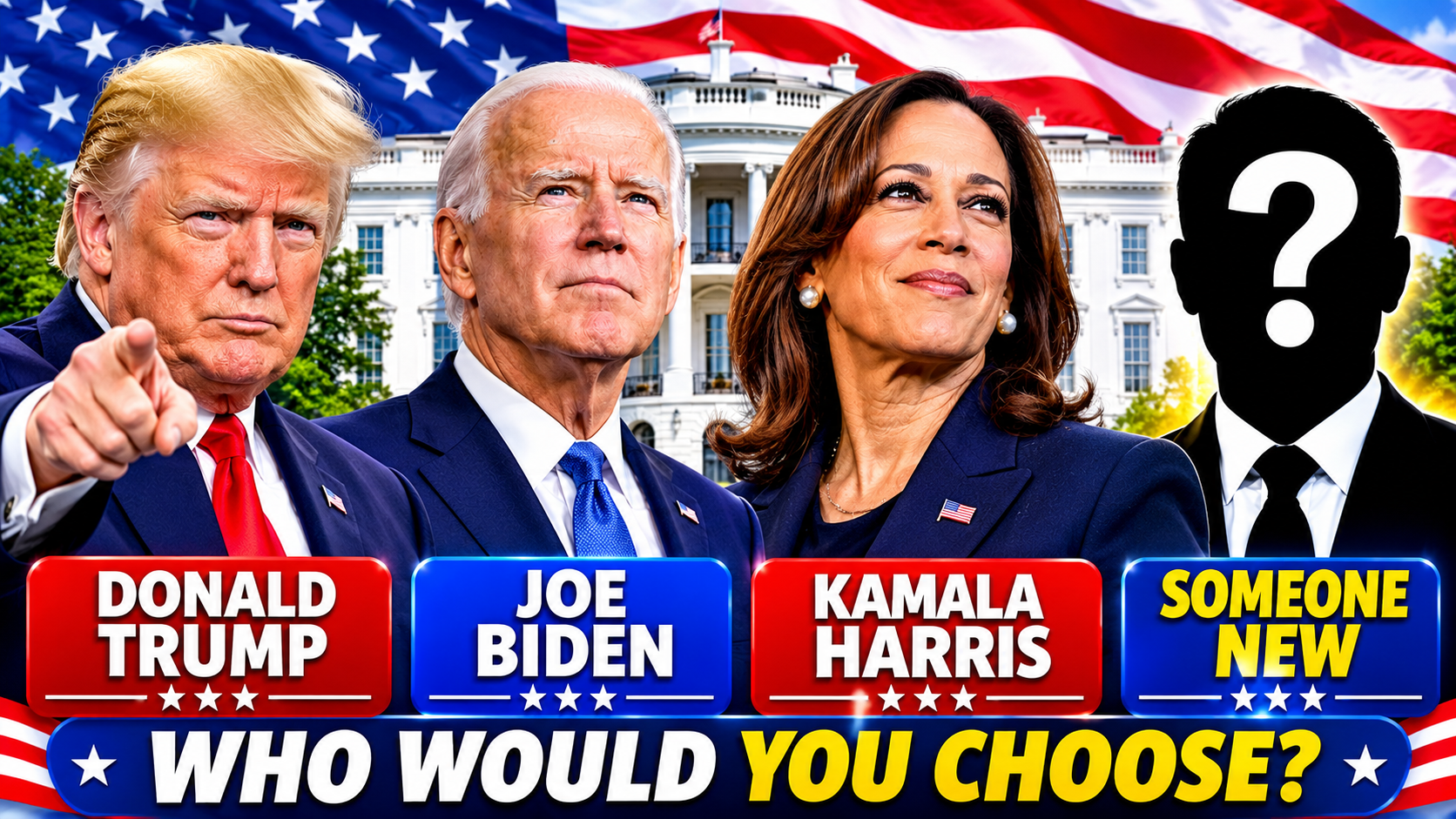
Your graphic asks people to choose among Donald Trump, Joe Biden, Kamala Harris, and Someone New.
The surveys discussed here ask different questions about potential 2028 primary candidates and broader political opinions.
They cannot be used to claim that one of those four quiz options has received a particular percentage of national support.
The best way to use the information is to provide readers with the actual polling context and then invite them to express their own opinions.
That makes the discussion more transparent and useful.
PART NINETEEN: HOW TO READ FUTURE PRESIDENTIAL POLLS WITHOUT BEING MISLED
As the 2028 election approaches, more polling organizations will publish surveys about potential candidates.
Some will examine party nominations.
Others will examine hypothetical general-election matchups.
Some will focus on presidential approval.
Others will study specific policy issues.
Readers should understand that these measurements answer different questions.
Here are five useful habits for following political polls.
FIRST: CHECK THE DATE.
A poll conducted several months ago may no longer reflect current public opinion.
Always look for the fieldwork dates, not just the date an article was published.
SECOND: CHECK WHO WAS SURVEYED.
A poll of all adults is different from a poll of registered voters.
A survey of intended party-primary voters is different from both.
THIRD: READ THE EXACT QUESTION.
A candidate receiving support in a closed-ended list may receive a different result when respondents are asked to name someone without being shown options.
FOURTH: COMPARE MORE THAN ONE SURVEY.
Different pollsters may produce different results.
Looking at multiple credible surveys can provide a broader understanding of public opinion.
FIFTH: SEPARATE FACTS FROM COMMENTARY.
A polling percentage is a measurement.
An explanation of why that percentage changed is an interpretation.
A prediction about what will happen in 2028 is a separate claim.
Readers should be able to distinguish all three.
These habits are useful not only during presidential elections but also when following congressional elections, state elections, referendums, and other public opinion research.
PART TWENTY: THE BIG QUESTION — WHAT KIND OF LEADERSHIP DO AMERICANS WANT?
Behind every presidential poll is a much larger question.
What do Americans expect from the person who occupies the White House?
Some people prioritize economic opportunity.
Others focus on national security, healthcare, immigration, education, or the country’s international relationships.
Some want continuity in government policies.
Others want major changes.
There is no single explanation that captures every voter’s priorities.
The United States is a large and diverse country, and its citizens have different experiences and expectations.
A family concerned about housing costs may evaluate a presidential candidate differently from a business owner worried about taxes and regulations.
A young adult entering the workforce may prioritize employment and education.
An older voter may place greater importance on retirement programs and healthcare.
A person who follows international affairs closely may focus on diplomacy and national security.
These differences are part of the democratic process.
A presidential candidate must present ideas to a country that does not have one single political viewpoint.
That makes it important for voters to examine proposals carefully and consider how decisions might affect people with different circumstances.
The most useful political conversations are not necessarily the ones in which everyone agrees.
They are the conversations in which people explain their reasons, ask meaningful questions, and consider information that may challenge their assumptions.
The 2028 election will provide another opportunity for Americans to express their political preferences.
But the process of understanding those preferences begins long before election day.
FINAL THOUGHT: THE NUMBERS ARE ONLY THE BEGINNING OF THE CONVERSATION
The latest November 2026 polling provides an early look at the political figures attracting attention as Americans begin considering the 2028 presidential election.
The Emerson College survey identified several potential Democratic and Republican candidates, with different results depending on whether respondents were given a list.
The Economist/YouGov survey also found a range of names receiving support among people intending to participate in their party’s 2028 primary.
Meanwhile, questions about inflation, the economy, political leadership, and the country’s direction demonstrate that voters are thinking about more than individual personalities.
These findings are useful, but they are not final election results.
There is still time for political priorities to change, new candidates to emerge, and voters to reconsider their preferences.
The most important thing for readers is to understand what the numbers actually measure.
A nomination poll is not a general-election result.
A presidential approval rating is not a direct voting preference.
And a Facebook opinion poll is not a scientifically representative national survey unless it uses an appropriate research design and sampling method.
Each serves a different purpose.
For now, the discussion about America’s next president is continuing.
And as new information becomes available, Americans will have more opportunities to compare candidates, examine their policies, and consider the direction they want their country to take.
🇺🇸 NOW WE WANT TO HEAR FROM YOU!
After looking at the political discussion and the latest polling information, there is one question worth asking.
IF YOU COULD EXPRESS YOUR PERSONAL PREFERENCE, WHICH OPTION WOULD YOU CHOOSE?
A. DONALD TRUMP
B. JOE BIDEN
C. KAMALA HARRIS
D. SOMEONE NEW
Would you prefer a familiar political figure, or would you rather see a different generation of leadership?
What qualities matter most to you when evaluating a president?
Is it economic policy, experience, healthcare, immigration, education, foreign policy, or something else?
Share your thoughts and explain your choice.
Different opinions are welcome. Please keep the discussion respectful and remember that the purpose of a political conversation is to exchange ideas, not attack people who disagree.
👇 COMMENT YOUR ANSWER: A, B, C, OR D!
🇺🇸 THE FUTURE OF AMERICA IS A CONVERSATION WORTH HAVING.