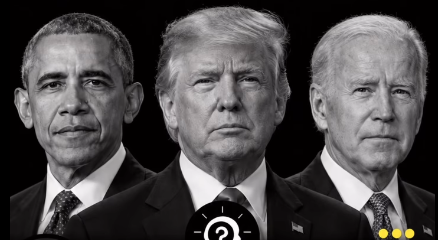
There are certain questions in American politics that can immediately start a heated discussion. Some questions divide political parties, others challenge people’s beliefs, and some force Americans to reconsider what they expect from the person sitting in the Oval Office.
This is one of those questions.
Which U.S. president has faced the most serious corruption controversies: Joe Biden, Barack Obama, Richard Nixon, or Donald Trump?
It sounds like a simple multiple-choice question. You look at the four names, choose the one you believe deserves the answer, and leave your vote in the comments.
But the subject is much more complicated than choosing a letter.
Corruption in government is not simply about whether someone belongs to a particular political party. It is about power, responsibility, transparency, accountability, and the relationship between public office and private interests.
When Americans elect a president, they are giving that individual an extraordinary level of responsibility. The president has access to sensitive information, influences national policy, represents the country internationally, appoints important officials, and makes decisions that can affect millions of lives.
That level of power comes with an equally important responsibility.
The American public has a right to expect honesty, integrity, and accountability from its highest elected official.
But what happens when a president becomes involved in a controversy involving ethics, conflicts of interest, questionable decisions, political influence, or the possible misuse of public authority?
What happens when supporters defend the president while critics demand investigations?
And how should Americans distinguish between a proven act of corruption, an official investigation, a political accusation, and a controversy that remains disputed?
These are important questions that deserve more than a quick argument on social media.
Before choosing A, B, C, or D, it is worth looking at the four presidents and understanding why their names can generate such different reactions.
1. JOE BIDEN: QUESTIONS ABOUT FAMILY BUSINESS, POLITICAL INFLUENCE, AND PUBLIC TRUST
Joe Biden served as the 46th president of the United States from January 2021 to January 2025.
Before becoming president, he spent decades in American politics, including serving as a U.S. senator and vice president under Barack Obama.
Throughout his political career, Biden developed a reputation among supporters as an experienced politician who understood the federal government and American foreign policy.
However, his presidency and political career also became the subject of several controversies, particularly involving his family, business relationships, and questions about possible political influence.
One of the most widely discussed subjects involved his son, Hunter Biden.
Hunter Biden’s business activities became a major political issue, especially because of his international business relationships and the possibility that his family connections could create questions about access and influence.
Critics argued that the Biden family’s business activities deserved greater scrutiny.
They questioned whether Hunter Biden benefited from his father’s political position and whether people doing business with him believed that the Biden name could provide valuable connections.
These questions became central to political investigations and public debate.
Republican lawmakers investigated the family’s financial relationships and examined whether Joe Biden had improperly used his political influence to benefit relatives.
However, it is important to distinguish allegations from established findings.
The investigations generated significant political controversy, but allegations that Joe Biden personally participated in criminal corruption are not automatically proven by the existence of business relationships involving his relatives.
Americans should examine the actual evidence rather than assume that every accusation is true.
Another major controversy involved Biden’s handling of classified documents.
After leaving the vice presidency, classified documents were discovered at locations associated with him, including his home and former office.
The discovery raised questions about document handling and whether proper procedures had been followed.
Special Counsel Robert Hur investigated the matter and issued a report in 2024.
The investigation did not result in criminal charges against Biden.
Nevertheless, the controversy created another difficult political discussion about responsibility, government transparency, and the standards expected of former senior officials.
For Biden’s critics, these issues contributed to concerns about judgment, transparency, and accountability.
His supporters, meanwhile, argued that political opponents often exaggerated the allegations and presented disputed claims as established facts.
This difference in interpretation is precisely why the subject remains politically sensitive.
The larger question is not simply whether a president’s family has been involved in controversial business activities.
It is whether a president personally misused the authority of the office, whether credible evidence supports that conclusion, and whether the government applied the same standards it would apply to anyone else.
Those distinctions matter.
A democracy cannot function properly if political accusations are automatically treated as convictions.
At the same time, public officials should not be exempt from legitimate questions simply because they hold powerful positions.
Americans have every reason to demand clear answers when questions about political influence and private financial interests arise.
So, when people look at Joe Biden’s record, what should matter most?
Should the focus be on the controversies involving members of his family?
Should it be on the investigations and their findings?
Or should Americans judge him primarily on his own actions and decisions while serving as president?
Those are questions worth considering before casting a vote.
2. BARACK OBAMA: QUESTIONS ABOUT GOVERNMENT POWER, TRANSPARENCY, AND ACCOUNTABILITY
Barack Obama served as the 44th president of the United States from January 2009 to January 2017.
His election was a historic moment in American politics.
He became the first African American president, and his campaign attracted enormous public attention both inside and outside the United States.
Supporters viewed him as a symbol of political change and a leader who promised greater transparency, a different approach to government, and a new direction for the country.
However, like every modern president, Obama faced criticism and controversies during his time in office.
Some of the most important debates involved government surveillance, national security, the use of executive power, and the transparency of federal agencies.
One major controversy involved the National Security Agency’s surveillance programs.
In 2013, former intelligence contractor Edward Snowden disclosed classified information about extensive government surveillance activities.
The disclosures revealed the scale of certain intelligence programs and triggered an international debate about privacy, national security, and the government’s ability to collect information.
For critics, the revelations raised serious concerns about the relationship between individual freedoms and government authority.
They questioned whether the government had gone too far in collecting information about ordinary people.
They also questioned how much the public should know about intelligence programs operating in its name.
Obama’s administration defended the importance of intelligence gathering in protecting national security.
Officials argued that surveillance programs operated within legal frameworks and were intended to identify threats.
Nevertheless, the disclosures created a lasting debate about whether the government had maintained an appropriate balance between national security and individual privacy.
Another controversial issue involved the use of drones in counterterrorism operations.
During Obama’s presidency, the United States continued and expanded certain targeted operations against suspected terrorist groups.
These operations raised difficult questions about civilian casualties, executive authority, oversight, and the limits of presidential power.
Critics argued that the administration needed greater transparency and stronger accountability.
Supporters defended the operations as part of the country’s national security strategy.
Again, the disagreement involved more than political party preferences.
It raised fundamental questions about what powers a president should possess and what safeguards should exist when those powers are used.
Obama’s administration also faced controversy involving the Internal Revenue Service.
In 2013, the IRS acknowledged that some conservative groups seeking tax-exempt status had received additional scrutiny based on their names and political characteristics.
The matter triggered congressional investigations and widespread criticism.
The controversy raised concerns about whether government agencies were treating organizations fairly regardless of their political beliefs.
Investigations examined the conduct of IRS employees and the agency’s internal processes.
The issue became an important political dispute because Americans generally expect federal agencies to operate impartially.
People should not have to worry that their political beliefs will determine how they are treated by government institutions.
Obama’s critics argued that the controversy damaged public confidence in the administration.
His defenders emphasized that investigations did not establish that Obama personally directed the IRS targeting activities.
That distinction is important.
A controversy involving an agency operating under a presidential administration does not automatically establish that the president personally ordered or participated in misconduct.
However, presidents are ultimately responsible for the executive branch, and the public has a legitimate interest in examining how their administrations respond to serious institutional failures.
Obama’s presidency therefore raises a broader question about accountability.
Should a president be judged only by actions that can be personally connected to him?
Or should the president also be judged by the conduct of agencies operating under his administration?
This is a difficult question, but it is one that deserves consistent treatment.
If Americans demand transparency from one administration, they should demand it from every administration.
Political loyalty should never replace the examination of evidence.
3. RICHARD NIXON: WATERGATE AND ONE OF THE BIGGEST POLITICAL SCANDALS IN AMERICAN HISTORY
Richard Nixon served as the 37th president of the United States from 1969 until his resignation in August 1974.
His presidency is permanently associated with one of the most significant political scandals in American history: Watergate.
Unlike many political controversies that involve competing accusations and interpretations, Watergate produced extensive documentary evidence, criminal prosecutions, congressional investigations, and a constitutional crisis.
The scandal began with a break-in at the Democratic National Committee headquarters in the Watergate complex in Washington, D.C., in June 1972.
Five men were arrested after entering the building.
The incident initially appeared to be a burglary.
However, investigations gradually uncovered connections between the burglars and individuals associated with Nixon’s reelection campaign.
As journalists, investigators, and congressional committees examined the case, the scandal expanded.
The central issue became whether people connected to the president’s political operation had attempted to interfere with the opposition party and whether the administration had tried to cover up what happened.
The investigation raised serious questions about the abuse of presidential power.
One of the most important discoveries involved Nixon’s White House recording system.
The existence of recordings meant investigators could examine conversations that took place inside the White House.
These recordings eventually became critical evidence.
The controversy intensified as the public learned more about attempts to obstruct the investigation and conceal information.
The Watergate scandal was no longer simply about a break-in.
It became a question about whether a president and members of his administration had attempted to use government power to protect themselves from political and legal consequences.
The constitutional consequences were enormous.
Congressional investigators continued examining the scandal, and the Supreme Court ruled in United States v. Nixon in 1974 that Nixon had to comply with a subpoena for the presidential recordings.
The decision rejected the idea that a president could use an absolute claim of executive privilege to withhold relevant evidence in a criminal investigation.
The recordings revealed damaging conversations and further weakened Nixon’s position.
As the political crisis intensified, members of his own political party began withdrawing their support.
Facing the likelihood of impeachment and removal from office, Nixon announced his resignation on August 8, 1974.
He left office the following day.
His resignation made him the first and only U.S. president to resign from the presidency.
His successor, Gerald Ford, later granted Nixon a full pardon for federal offenses he might have committed while president.
That decision generated another major national debate.
Some Americans believed the pardon was necessary to help the country move forward.
Others believed it prevented a fuller legal examination of Nixon’s conduct.
Regardless of those disagreements, Watergate left a permanent mark on American political history.
It demonstrated that the presidency is not above the law.
It also showed why independent investigations, a free press, congressional oversight, and judicial review are essential parts of a functioning democracy.
For many Americans, Nixon’s involvement in the Watergate scandal makes him a particularly significant figure when discussing presidential corruption.
However, a serious discussion should still examine the specific evidence and historical circumstances rather than relying only on his reputation.
The most important lesson of Watergate is that public office must never become a personal shield against accountability.
The president is powerful, but presidential power has constitutional limits.
And when those limits are challenged, democratic institutions must be able to respond.
4. DONALD TRUMP: CONFLICTS OF INTEREST, IMPEACHMENTS, LEGAL CONTROVERSIES, AND PRESIDENTIAL ACCOUNTABILITY
Donald Trump became the 45th president of the United States in January 2017 and later returned to the presidency in January 2025 as the 47th president.
His political career has generated some of the most intense debates in modern American history.
Supporters view him as a leader willing to challenge Washington’s political establishment, question traditional institutions, and pursue policies they believe benefit the country.
Critics, on the other hand, have raised serious concerns about his relationship with democratic institutions, the use of presidential authority, conflicts of interest, and his approach to political accountability.
One important controversy involved potential conflicts of interest connected to his business empire.
Before entering the White House, Trump was a well-known businessman with interests in real estate, hotels, licensing, and other commercial activities.
His continued connections to businesses during his presidency generated questions about whether private financial interests could overlap with presidential responsibilities.
Critics argued that the presidency created a situation in which foreign governments, political organizations, and private individuals might have financial relationships with businesses connected to the president.
Supporters responded that Trump had not violated the law simply by entering office while maintaining a business background.
The debate raised an important question about how presidents should separate private business interests from public responsibilities.
Another major controversy involved Trump’s two impeachments during his first term.
In December 2019, the House of Representatives impeached him for abuse of power and obstruction of Congress.
The first impeachment centered on his dealings with Ukraine.
The controversy involved a telephone conversation with Ukrainian President Volodymyr Zelenskyy and questions about whether Trump had improperly pressured Ukraine to investigate political matters involving Joe Biden and his son.
Trump denied wrongdoing.
The House approved articles of impeachment, but the Senate acquitted him in February 2020.
His second impeachment came in January 2021, following the January 6 attack on the U.S. Capitol.
The House charged him with incitement of insurrection.
Trump was again acquitted by the Senate, although seven Republican senators voted to convict him.
These events became major parts of the national debate about presidential responsibility and the limits of political power.
Trump also faced several criminal and civil legal proceedings after his first presidency.
One especially significant case involved falsifying business records connected to a payment made before the 2016 election.
In May 2024, a New York jury found Trump guilty on 34 felony counts of falsifying business records.
He became the first former U.S. president convicted of felony crimes.
In January 2025, he received an unconditional discharge, meaning no imprisonment, fine, or probation was imposed in that case.
Other legal controversies involved the handling of classified documents and efforts to challenge the results of the 2020 presidential election.
The cases involved different legal questions and procedural developments.
It is important not to treat every accusation, civil dispute, investigation, or criminal charge as if it had the same legal status.
A conviction is different from an indictment.
An investigation is different from a proven violation.
And an allegation is not automatically a fact.
These distinctions are essential when evaluating any political figure.
Trump’s supporters often argue that many investigations against him were politically motivated and that the political establishment treated him unfairly.
His critics argue that the seriousness and number of controversies demonstrate why presidential accountability is so important.
Both perspectives are part of the broader political debate.
However, the central question remains the same: What does the evidence actually show, and what standards should apply to a president?
Should presidents face stricter ethical expectations because of the power they hold?
Should they be required to separate their private financial interests more clearly from their official responsibilities?
And should the same standards apply whether the president is a Republican or a Democrat?
These questions matter regardless of whether someone supports or opposes Trump.
The presidency belongs to the American people, not to one political party.
BEFORE YOU CHOOSE YOUR ANSWER, THINK ABOUT WHAT CORRUPTION REALLY MEANS
After looking at these four presidents, one thing becomes clear: presidential controversies are not all the same.
Watergate involved a documented political scandal and an effort to obstruct an investigation.
The Obama administration faced controversies involving surveillance, government transparency, and agency accountability.
The Biden administration faced significant questions involving family business relationships and the handling of classified documents.
Trump faced major controversies involving conflicts of interest, impeachments, and criminal and civil legal proceedings.
These events cannot all be placed into one category without examining their facts, evidence, legal outcomes, and historical consequences.
A responsible comparison requires more than counting headlines.
It requires asking what happened, who was involved, what evidence exists, and whether the president personally participated in misconduct.
That is why this question deserves a thoughtful discussion rather than a simple partisan argument.
And now, America, it is your turn.
Which of these four presidents do you believe has faced the most serious corruption controversies?
A. Joe Biden
B. Barack Obama
C. Richard Nixon
D. Donald Trump
Choose your answer carefully, because the most interesting part of this discussion is not simply which letter receives the most votes.
It is the reasoning behind those votes.
What evidence influenced your decision?
Which controversy do you consider the most serious?
And do you believe American presidents are held to the same standards regardless of their political party?
PART 1 ENDS HERE — THE DEEPER DISCUSSION CONTINUES IN PART 2.
THE FINAL DEBATE EVERY AMERICAN SHOULD CONSIDER
5. IS PRESIDENTIAL CORRUPTION REALLY ABOUT POLITICAL PARTY, OR IS IT ABOUT POWER?
After examining the controversies surrounding Joe Biden, Barack Obama, Richard Nixon, and Donald Trump, an important question remains.
Why do Americans often have completely different opinions about presidential corruption, even when they are discussing similar issues?
The answer may have something to do with political identity.
In the United States, political parties have become an important part of how many people understand government, public policy, and national leadership.
For some Americans, supporting a president is closely connected to their personal beliefs about the economy, immigration, national security, healthcare, taxes, and the future of the country.
For others, political loyalty is connected to a broader feeling that their party represents their values and interests.
There is nothing unusual about having political preferences.
Americans have the right to support whichever candidate they believe represents them best.
However, problems can arise when political loyalty becomes more important than accountability.
Imagine a situation in which a president from your preferred political party faces serious allegations.
Would you demand an independent investigation?
Would you expect the president to answer difficult questions?
Would you want the evidence examined, even if the outcome could damage your political party?
Now imagine that the same controversy involves a president from the opposing party.
Would you apply exactly the same standards?
This is where the discussion becomes interesting.
One of the greatest challenges in American politics is maintaining consistent standards when evaluating people with enormous political power.
If an accusation is serious enough to deserve investigation when it involves a Republican president, it should also deserve investigation when it involves a Democratic president.
The opposite is equally true.
A president should not automatically be considered guilty simply because political opponents make accusations.
The evidence must matter more than the political identity of the person involved.
This principle is essential because corruption is not exclusively a Republican problem or a Democratic problem.
The potential misuse of public authority can occur under any administration.
It can involve different institutions, different individuals, and different circumstances.
The most important question should always be whether public power was used improperly and whether the available evidence supports that conclusion.
Americans should never have to choose between political loyalty and their responsibility to demand honest government.
A healthy democracy needs citizens who are willing to question their own political leaders.
It also needs citizens who are willing to recognize when accusations against political opponents are unsupported or exaggerated.
That is what makes a meaningful political discussion possible.
6. WHY WATERGATE REMAINS AN IMPORTANT STANDARD IN THE DISCUSSION
When Americans discuss presidential corruption, it is almost impossible to avoid the Watergate scandal.
The events surrounding Richard Nixon’s presidency remain one of the most important examples of why presidential accountability matters.
Watergate demonstrated that political power can create enormous pressure to protect individuals in positions of authority.
It also demonstrated how important it is for democratic institutions to operate independently.
The scandal did not end simply because the president denied wrongdoing.
Journalists continued investigating.
Congressional committees examined the evidence.
The courts considered important constitutional questions.
Eventually, the presidential recordings provided evidence that helped reveal the extent of the crisis.
The entire episode showed that even the most powerful elected official in the country must operate within the Constitution.
But Watergate also teaches another important lesson.
A political scandal should not be evaluated only by how much attention it receives.
The public should examine the underlying conduct.
What happened?
Who participated?
What evidence was presented?
Was there an attempt to obstruct an investigation?
Were public institutions pressured or misused?
Did the president personally participate?
These questions help distinguish a serious abuse of authority from a controversy that may involve administrative mistakes, political disagreements, or unsupported accusations.
The historical significance of Watergate is not simply that Nixon resigned.
It is that the American political system demonstrated that presidential authority has limits.
That lesson remains relevant today.
No president should be treated as more powerful than the Constitution.
No political party should be allowed to decide whether evidence matters.
And no administration should expect the American people to ignore legitimate questions simply because the questions are politically inconvenient.
The country needs institutions that can investigate wrongdoing without fear or favoritism.
It also needs a public that understands why those institutions matter.
7. SHOULD A PRESIDENT BE RESPONSIBLE FOR THE ACTIONS OF FAMILY MEMBERS?
Another difficult issue in modern American politics involves the relationship between a president and members of their family.
This question became especially prominent in political discussions surrounding Joe Biden and Donald Trump.
Presidents and presidential candidates are public figures.
Their relatives, however, are not automatically responsible for the official decisions of the president.
At the same time, family relationships can create potential conflicts of interest when private business activities overlap with political influence.
Consider the following situation.
A relative of a president has a business relationship with a foreign company.
The relative has access to influential people because of the family connection.
Business partners may believe that being associated with the president’s family provides an advantage.
Does that automatically mean the president committed corruption?
No.
But does it justify legitimate questions about possible influence, transparency, and ethical boundaries?
Absolutely.
There is an important difference between examining a potential conflict of interest and declaring that a crime occurred.
Investigators must establish evidence.
The public deserves accurate information.
And presidents should be willing to explain situations that could undermine confidence in their administration.
The same principle applies regardless of political party.
A president should not receive automatic protection because a controversy involves a family member.
But neither should a family member’s actions automatically become proof of presidential criminal conduct.
The distinction is important.
America needs a standard that protects both accountability and fairness.
If a president personally participates in an improper arrangement, that conduct deserves serious examination.
If a family member acts independently, the evidence should establish that distinction.
The public should not have to rely on rumors, political advertisements, or viral social media posts to understand important ethical questions.
Clear documentation and independent investigations are far more valuable.
Ultimately, the American people deserve to know whether public office is being used to serve the country or whether private interests are receiving special treatment.
That expectation should apply to every president.
8. DOES A PRESIDENTIAL IMPEACHMENT MEAN THAT THE PRESIDENT IS CORRUPT?
The word impeachment appears frequently in political discussions, especially when Americans discuss Donald Trump.
However, many people misunderstand what impeachment actually means.
Impeachment is a constitutional process through which the House of Representatives brings formal charges against a federal official.
It does not automatically mean that the official has been convicted of a crime.
The Senate conducts the trial and determines whether to convict and remove the official.
A president can be impeached by the House and subsequently acquitted by the Senate.
That distinction matters when comparing presidential controversies.
Donald Trump was impeached twice during his first term.
The first impeachment involved allegations of abuse of power and obstruction of Congress connected to his dealings with Ukraine.
The second involved the events surrounding January 6, 2021.
Both cases generated significant political debate.
Trump denied wrongdoing and was acquitted by the Senate in both proceedings.
People can disagree about whether the Senate made the right decisions.
However, an accurate historical discussion must recognize the actual constitutional outcomes.
The larger question is whether impeachment should influence how Americans evaluate presidential leadership.
Some people believe impeachment represents a serious warning that a president has violated public trust.
Others argue that impeachment can become a partisan political weapon when Congress is divided.
Both concerns deserve consideration.
The impeachment process exists because the Constitution recognizes that presidents must be accountable.
But the process also requires political judgment, constitutional standards, and careful examination of the facts.
It should not be treated as an automatic criminal conviction.
And it should not be dismissed as meaningless simply because a president’s political supporters disagree with the charges.
Americans should examine the allegations, the evidence, the constitutional arguments, and the final outcome.
That is how responsible political discussion should work.
9. WHAT DOES IT MEAN WHEN A PRESIDENT IS CONVICTED OF A CRIME?
There is another distinction that deserves attention.
A criminal conviction is different from a political accusation.
A person can face criticism for years without ever being charged with a crime.
An individual can be investigated without being convicted.
A person can be charged and later acquitted.
And a person can be convicted after a jury examines the evidence and reaches a verdict.
These are different legal situations.
Donald Trump’s 2024 New York criminal conviction became an extraordinary moment in American history because he became the first former U.S. president convicted of felony crimes.
The case involved falsifying business records in connection with a payment made before the 2016 presidential election.
A jury found him guilty on 34 counts.
The sentence imposed in January 2025 was an unconditional discharge, meaning no imprisonment, fine, or probation was imposed.
This legal outcome became a major part of the public debate about presidential accountability.
Supporters and critics interpreted the case differently.
Some supporters argued that the prosecution was politically motivated.
Critics argued that the case demonstrated that former presidents should not receive special treatment under the law.
Whatever political position someone holds, the legal outcome should be described accurately.
A conviction should not be described as merely an accusation.
At the same time, one criminal conviction does not automatically answer every broader question about presidential corruption.
The public must consider the specific conduct involved, the legal findings, and the standards being applied.
It is also important to recognize that the other three presidents in this quiz faced different types of controversies.
Nixon’s Watergate scandal involved obstruction and abuse of presidential power.
Obama faced controversies involving surveillance, government transparency, and federal agency accountability.
Biden faced investigations and questions involving family business relationships and classified documents.
Trump faced impeachment proceedings, conflicts-of-interest concerns, and significant criminal and civil litigation.
A fair comparison requires understanding these differences.
Simply counting allegations or news headlines cannot produce a reliable historical ranking.
10. HOW MUCH SHOULD PUBLIC TRUST MATTER WHEN JUDGING A PRESIDENT?
There is another side to this discussion that goes beyond legal proceedings.
A president’s responsibility is not limited to avoiding criminal convictions.
Public trust is also essential to democratic leadership.
Americans expect presidents to make decisions in the national interest.
They expect leaders to communicate honestly.
They expect government institutions to operate fairly.
And they expect elected officials to understand that public office is a responsibility, not personal property.
When public trust disappears, even ordinary government decisions can become controversial.
People begin questioning official explanations.
They become suspicious of investigations.
They may believe government institutions are protecting powerful individuals.
And they may lose confidence in the political system itself.
This can create a dangerous cycle.
One political group believes the government is being unfair to its leader.
Another group believes the same leader is escaping accountability.
Both sides become increasingly convinced that the other side is ignoring the truth.
Eventually, political arguments become less about evidence and more about defending a team.
That is not healthy for the country.
A president should understand that public confidence is difficult to build and easy to damage.
Even when a president believes an accusation is unfair, answering legitimate questions clearly can help maintain trust.
Likewise, political opponents should understand that making unsupported accusations can damage public confidence in the entire political system.
The American people deserve better than endless accusations without evidence.
They also deserve better than political leaders who refuse to answer difficult questions.
A strong democracy requires both accountability and fairness.
It requires leaders who respect the law and citizens who are willing to examine the facts.
11. WHAT SHOULD AMERICANS LOOK FOR WHEN EVALUATING PRESIDENTIAL CORRUPTION?
Instead of relying entirely on political opinions, Americans can consider several important questions when evaluating allegations involving a president.
First: Was there an actual misuse of public authority?
A president has enormous power.
If that power is used to benefit private interests, punish political opponents, interfere with investigations, or undermine public institutions, the conduct deserves serious scrutiny.
However, the evidence must establish what actually happened.
Second: Was there a personal financial benefit?
Financial relationships can create conflicts of interest.
Americans should examine whether a president or close associates received benefits connected to official decisions.
But a potential conflict of interest is not automatically proof of criminal corruption.
The circumstances and evidence matter.
Third: Was the conduct investigated independently?
Investigations should be based on evidence and conducted according to established legal standards.
Political pressure should not determine whether an investigation is opened, how it proceeds, or what conclusions are reached.
Fourth: Did the president cooperate with accountability?
Public officials should answer legitimate questions.
They should respect lawful oversight and avoid using their positions to obstruct investigations.
The public also has a right to know when investigations reach conclusions.
Fifth: Were the same standards applied to everyone?
This may be the most important question of all.
If Americans believe a president should be held accountable for a particular type of conduct, they should apply the same principle to every president.
It should not matter whether the individual is a Republican, a Democrat, conservative, liberal, popular, or unpopular.
The law should not depend on political popularity.
Sixth: What was the final legal or historical finding?
An accusation is the beginning of a question, not the end of an investigation.
Americans should distinguish between allegations, investigations, indictments, court findings, convictions, acquittals, and other official outcomes.
These distinctions help prevent misinformation and make political discussions more meaningful.
When people use these standards consistently, they can have much stronger conversations about the presidency.
12. WHY AMERICANS SHOULD NEVER STOP QUESTIONING THEIR LEADERS
The United States was founded on the idea that government authority should have limits.
The Constitution established separate branches of government because the people who hold political power should not be able to exercise unlimited authority.
Congress has oversight responsibilities.
The courts interpret and apply the law.
The executive branch carries out federal responsibilities.
The press investigates and reports on matters of public interest.
Citizens participate through elections, public debate, and civic engagement.
These institutions and responsibilities help protect the country from the concentration of power.
But institutions alone are not enough.
A democracy also depends on citizens who are willing to pay attention.
People must be willing to question decisions, examine evidence, and demand accountability.
They must also be willing to admit when information contradicts their political assumptions.
That is not always easy.
It can be uncomfortable to criticize a president you voted for.
It can also be uncomfortable to recognize that a political opponent may be correct about a particular issue.
But democracy is not supposed to be a competition in which one political party is always right.
It is a system in which different ideas and interests compete under constitutional rules.
The president is elected to serve the country.
That responsibility does not disappear when the president becomes popular.
It does not disappear when the president wins reelection.
And it does not disappear when the president’s political party controls Congress.
Public accountability must remain part of the American political system.
If Americans stop asking questions, powerful people may become less concerned about answering them.
If citizens stop demanding transparency, important decisions may receive less scrutiny.
And if political loyalty becomes more important than the truth, the entire country can suffer.
That is why discussions about presidential integrity are important.
They are not simply about criticizing individual politicians.
They are about protecting the principles that make representative government possible.
13. FOUR PRESIDENTS, FOUR DIFFERENT HISTORIES, AND ONE IMPORTANT QUESTION
Now that we have examined the four presidents, let’s return to the original question.
Which of these presidents has faced the most serious corruption controversies?
There is no universally accepted historical ranking that settles this question.
Each president’s controversies involve different circumstances.
Richard Nixon’s presidency became associated with Watergate, a scandal that involved a documented political cover-up, obstruction, and his eventual resignation.
Barack Obama’s administration faced major controversies involving government surveillance, national security, transparency, and federal agency conduct.
Joe Biden’s presidency and political career faced scrutiny involving family business relationships, political influence allegations, and classified documents.
Donald Trump’s political career has involved conflicts-of-interest concerns, two impeachments, and significant criminal and civil legal proceedings.
These are not identical situations.
They should not be treated as if they are interchangeable.
A fair judgment requires looking at the seriousness of the conduct, the evidence, the president’s personal involvement, the legal outcomes, and the consequences for American institutions.
Some Americans may believe that Nixon’s Watergate scandal represents the clearest historical example of presidential corruption.
Others may focus on Trump’s legal controversies and questions about the use of presidential authority.
Some may argue that the controversies involving Biden deserve greater scrutiny.
Others may point to the Obama administration’s surveillance programs and government transparency debates.
The purpose of this discussion is not to tell people which political opinion they must hold.
It is to encourage people to think carefully before reaching a conclusion.
A country with more than 300 million people will never have complete agreement about every president.
But Americans should be able to agree on something important:
No president should be above accountability.
No political party should receive a permanent exemption from scrutiny.
And no accusation should replace the need for evidence.
The future of American democracy depends on the willingness of citizens to demand these standards consistently.
🇺🇸 NOW WE WANT TO HEAR FROM YOU, AMERICA!
We have discussed four presidents, several major political controversies, and some of the most important questions surrounding honesty, integrity, and accountability in the White House.
Now it is your turn to share your opinion.
Look at the four choices one more time.
WHICH U.S. PRESIDENT HAS FACED THE MOST SERIOUS CORRUPTION CONTROVERSIES?
🔴 A. JOE BIDEN
🔵 B. BARACK OBAMA
🔴 C. RICHARD NIXON
🔵 D. DONALD TRUMP
Don’t just choose a letter.
Tell us what influenced your decision.
Was it a historical scandal?
Was it a criminal conviction?
Was it an investigation involving possible conflicts of interest?
Was it the use of presidential power?
Or was it a broader pattern of controversies that affected your confidence in a particular administration?
We want to hear your reasoning.
💬 FIVE QUESTIONS FOR THE COMMENT SECTION
1. Do you believe American presidents are held to the same standards regardless of their political party?
2. Should a president be held responsible for serious misconduct committed by people working in their administration?
3. Should family business relationships receive greater scrutiny when a relative of a president has access to political influence?
4. Which matters more when evaluating a president: legal findings, ethical standards, or public trust?
5. Do you believe Richard Nixon’s Watergate scandal remains the most important historical example of presidential corruption?
There are no political teams in this discussion that should be protected from legitimate questions.
Every president deserves to be evaluated based on evidence, actions, and established findings.
And every American deserves the opportunity to express an opinion respectfully.
🇺🇸 ONE FINAL THOUGHT
The most important responsibility of an American president is not to protect a political party, defend personal interests, or silence criticism.
It is to serve the American people.
The Oval Office is one of the most powerful positions in the world, but it is still a public office.
The person occupying it is not above the Constitution.
The person occupying it is not above legitimate investigations.
And the person occupying it should never expect unquestioning loyalty from citizens.
Americans can disagree about taxes, immigration, foreign policy, healthcare, education, and the economy.
They can support different candidates and vote for different parties.
That is part of democracy.
But when it comes to honesty, integrity, transparency, and accountability, the standards should be consistent.
If a president from your preferred party makes a mistake, ask questions.
If a president from the opposing party faces an accusation, demand evidence.
If an investigation produces a finding, examine it honestly.
And if someone abuses public authority, their political popularity should not protect them from accountability.
The United States does not belong to one president or one political party. It belongs to its people.
That is why these discussions matter.
That is why history matters.
And that is why Americans should never stop asking difficult questions about the people entrusted with leading their country.
👇 SO, WHAT IS YOUR ANSWER?
A, B, C, OR D?
Write your choice in the comments and explain your reasoning.
Share this discussion with friends and family members who enjoy American history and politics.
Let’s have a serious, respectful, and meaningful conversation.
🇺🇸 BECAUSE NO PRESIDENT SHOULD EVER BE ABOVE ACCOUNTABILITY.